
Selecting a help desk isn’t about choosing the “top” — it’s about finding the right solution for your business. Focus first on the platform’s core capabilities, then consider how easily it can scale as your company grows. Equally important is ensuring your team can use it efficiently and comfortably every day.
Starting out, Zendesk software is the best choice for handling customer issues. And there are many, many reasons for that. The helpdesk is fairly easy to set up. You can get the basic version up and running in just a day.
In the early stages, when you are trying to streamline your support team's functioning, you don’t need a system with advanced features. So, software with an intuitive UI that allows you to manipulate tickets and handle claims and problems fits just well.
Salesforce centralizes customer data, providing a 360-degree view for sales, service, and marketing teams to deliver personalized support. Yet customers expect anyone they contact to know their history.
Zendesk goes beyond, offering a purpose-built CX platform that combines centralized data with AI insights, flexible integrations, and built-in best practices for CX. This helps teams deliver faster, more accurate support and ensures a seamless, personalized experience at every touchpoint.
Check out the video for a visual comparison of Zendesk and Salesforce Cloud:
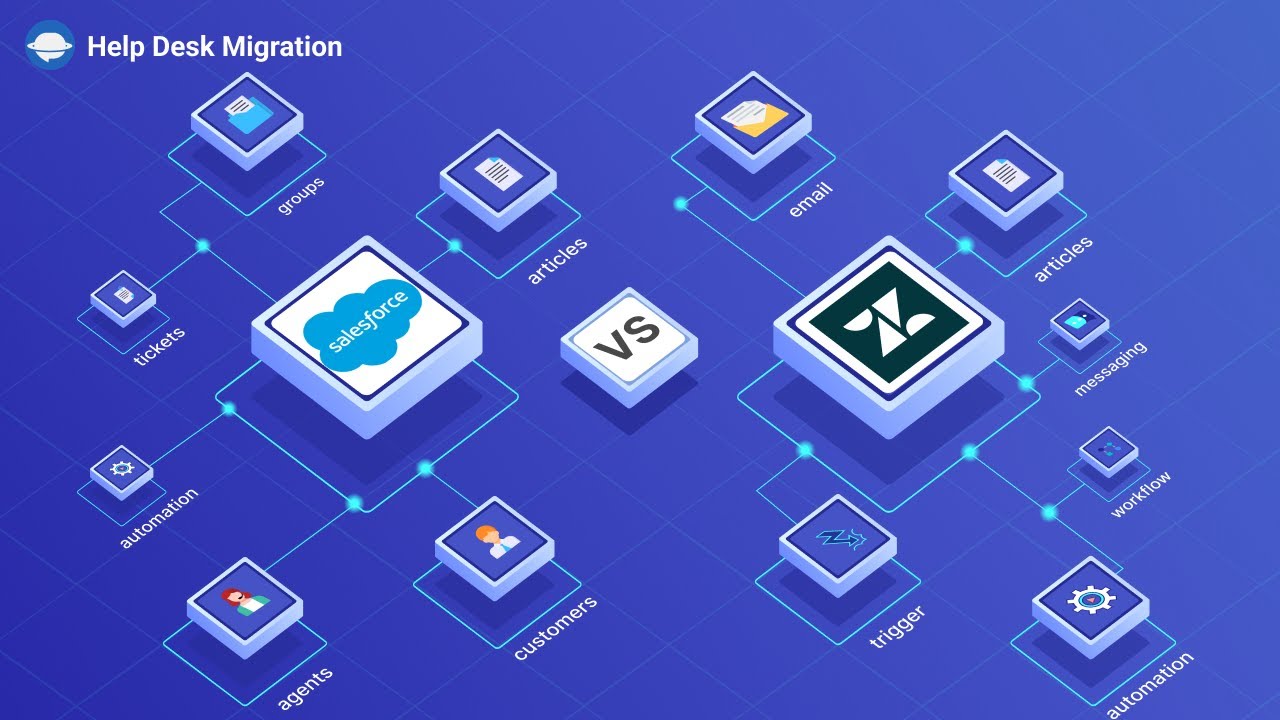
A Short Overview of Zendesk and Salesforce
Zendesk is software for managing customer issues. It allows you to consolidate all interactions with customers and provide seamless, personal, and efficient support.
Service Cloud is a client service solution on the Salesforce Platform. It provides a 360-degree view of your customers' inquiries and enables smart, fast, and personalized communication. Service Cloud offers functionality to automate processes, streamline workflows, and organize self-service materials.

Ready to switch to Zendesk?
Don’t have Zendesk account?
Take it for a spin for free with 14 days trial
Comparison: Zendesk vs Salesforce Service Cloud
| Feature | Zendesk | Salesforce Service Cloud |
| Primary Focus | Dedicated Customer Service (CX). Built for agent usability and quick ticket resolution. | CRM Suite Service Module. Designed to be a part of the larger Salesforce Customer 360 view. |
| Target Audience | Ideal for SMBs, mid-market companies, and enterprises that need fast time-to-value and minimal administrative overhead. | Large enterprises that already use Salesforce for Sales/Marketing or require deep customization and complex workflows. |
| Implementation | Quick and Easy (often days/weeks). Strong out-of-the-box functionality. | Longer and More Complex (often months). Requires more configuration and, often, a dedicated administrator or developer. |
| Agent Usability | Highly Intuitive. Clean, modern interface minimizes training time for support agents. | Complex. Interface can be overwhelming initially; designed for maximum data access rather than simplicity. |
| Ecosystem & Integration | Open Ecosystem. Excellent marketplace with thousands of integrations, functioning well as a standalone solution. | Native Integration. Seamlessly integrates with all other Salesforce Clouds (Sales, Marketing, etc.) for a 360° customer view. |
| Customization | Strong but focused on CX best practices. Customization can require expensive add-ons or technical knowledge at higher levels. | Extensive & Deep. Highly customizable to match virtually any unique business process, requiring the use of the powerful Salesforce Platform. |
| Pricing Model | Generally lower entry point and more transparent pricing for core CX features. | Higher overall cost due to licensing complexity, necessary add-ons, and potential consulting/development fees. |
| AI Capabilities | Strong, built-in AI models (e.g., Answer Bot) that are purpose-built for CX and work right away. | Leverages Einstein AI for predictive insights, powerful routing, and next-best-action, but often requires configuration to yield results. |
Choose Zendesk if:
- You are an SMB, a rapidly expanding mid-market organization, or a modern enterprise.
- You need to establish a reliable support system quickly with minimal IT resources.
- Your priority is agent usability and reducing the time agents spend resolving tickets.
- You plan to run the support platform independently of a large, core CRM.
Choose Salesforce Service Cloud if:
- You are a large enterprise or plan to be one.
- You have a dedicated IT team or budget for developers and administrators to manage a complex, highly customized system.
- Your business processes are unique and highly complex, requiring extensive customization.
- Zendesk: Focuses on being the best-of-breed, intuitive, quick-to-implement CX platform.
- Salesforce Service Cloud: Focuses on being a highly customized, enterprise-grade service module within the larger Salesforce CRM ecosystem.
Pricing Comparison
When comparing Salesforce vs. Zendesk pricing, it's worth mentioning that both companies offer monthly subscriptions and several basic plans. Zendesk has 5-tier pricing. The cheapest pricing plan starts at $19 per user per month.
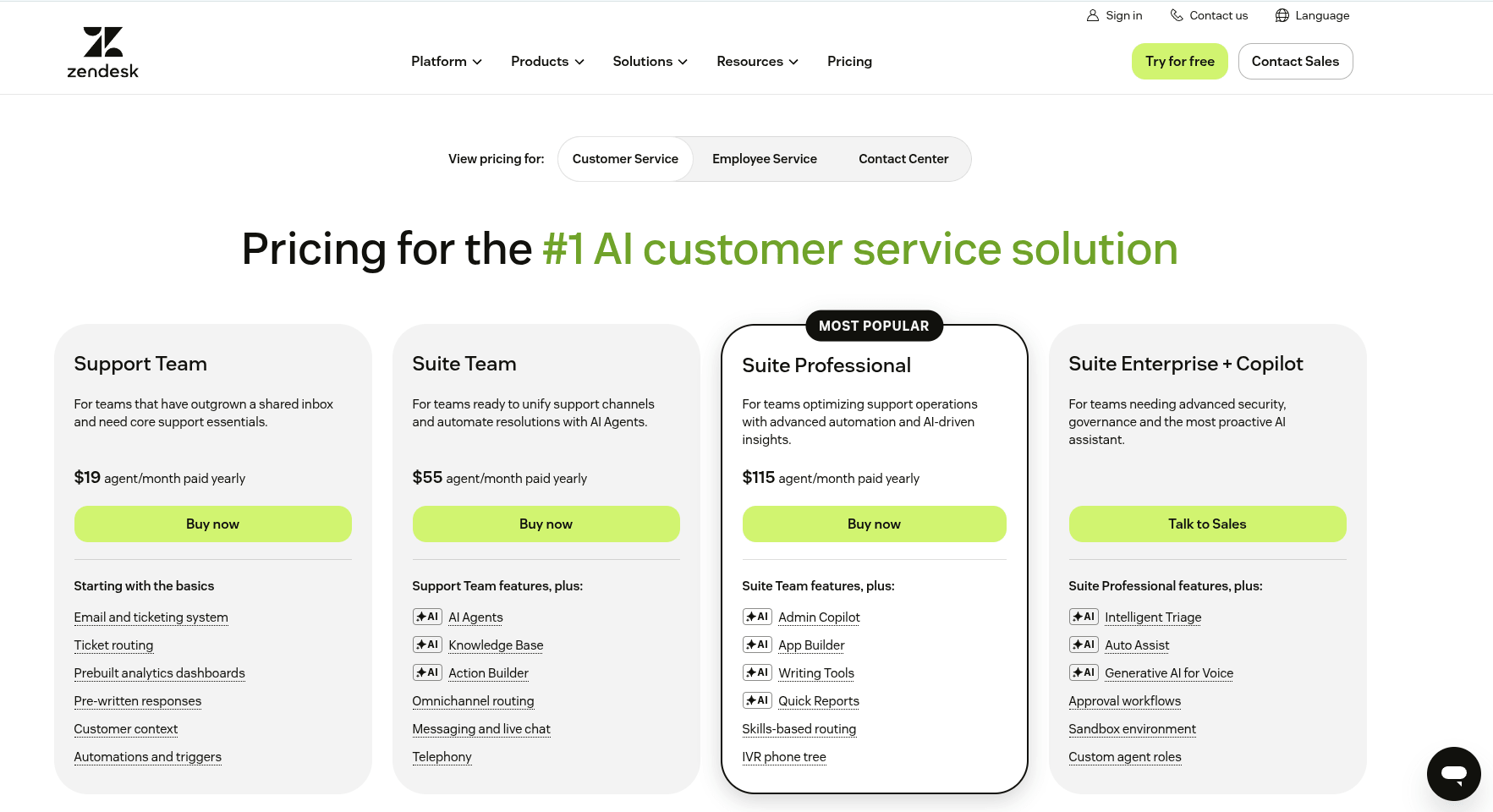
Salesforce offers 5 pricing plans to choose from. The starting price for Service Cloud is $25 per agent.
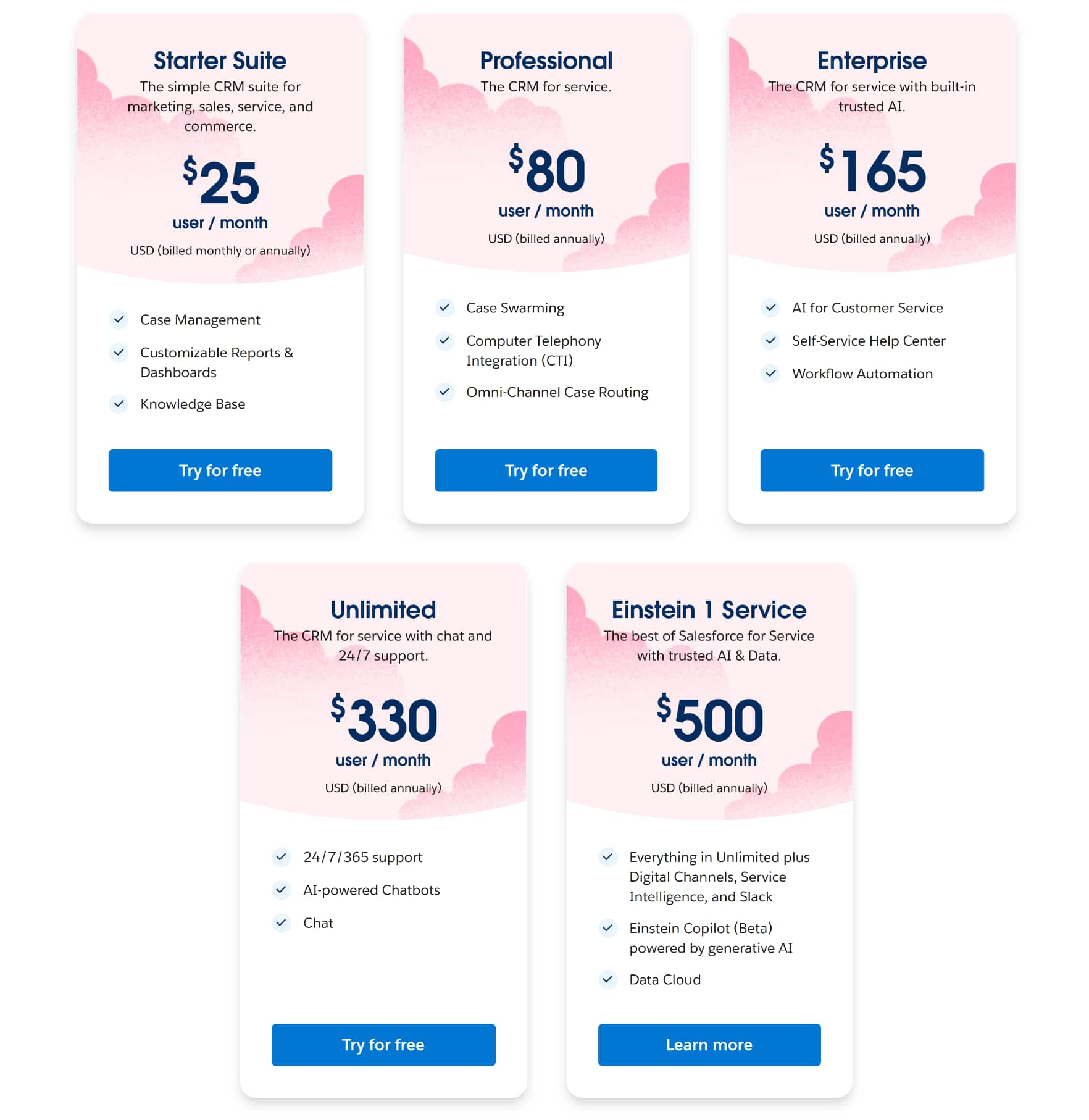
Likewise, the most popular Professional plan in Zendesk costs $115 per agent. At the same time, Service Cloud offers its most popular product for $165 per agent. As you can see, the price tag for Service Cloud is higher. Let’s go through their functionality now to find out what you pay for.
Common Zendesk and Salesforce Service Cloud features
Let's review Zendesk vs Salesforce Service Cloud features that are the core of help desk software solutions.
Ticket management
In Zendesk, you can manage ticket workflow, use various email templates, benefit from the platform's scheduling features, and manually choose and assign tickets to agents. You can automatically assign tickets to specific agents for the most productive customer communication using advanced automation and triggers.
In Service Cloud, there are no tickets but “cases.” The AI-powered routing of Salesforce Service Cloud Consultant allows you to assign cases to the agents that are best qualified to resolve them. Another Email integration of Service Cloud is a chronological timeline that shows the whole customer interaction history providing the necessary context for support engineers. Automating repetitive tasks can speed up the work of your support team.
Multi-Channel Support
Comparing Zendesk vs Salesforce Service Cloud, both of them enable agents to provide support across various digital channels. You choose the communication channels you want to use: email, chat, phone, and social networks. Then, you manage customer requests from one place via your workflow management tool.
Self Service Portal
A self-service portal is also essential when running Salesforce Service Cloud vs Zendesk comparison. With Zendesk guide, you can build a smart knowledge base in multiple languages. On Professional and Enterprise plans, you get the functionality to create community forums and branded customer support sites. Сonfigure Zendesk Support for your business type.
One of the professional features that Service Cloud offers is its Lightning Community Builder to create a customizable and branded portal or community within your Internal knowledge base for visual representation.
Zendesk specific features and integrations
A critical difference between Zendesk and Salesforce is that with Zendesk, you can survey your customers about their satisfaction out of the box. And then, compare your company's service against the service of top companies in the industry. The Benchmark tool gives insights on the most important metrics:
- percentage of satisfied customers;
- full resolution time and others.
You can extend Zendesk functionality with over 1,200 app integrations and Advanced reporting features from the Zendesk marketplace.
To save time and resources, opt for Professional Services. Zendesk delivers a wide range of services, from launching help desks to customizing and tune-up integrations, training users, and consolidating data between Zendesk instances for better user experience. Zendesk Professional Services' pricing goes from $8K per channel, and the price increases depending on the number of launched instances. But, considering you only need a secure and quick data transfer, that's quite a bit.
Likewise, you can consider Help Desk Migration to transfer your customer service data to Zendesk from another help desk. The migration costs vary based on the number of records, starting from $39. Our team has experience consolidating Zendesk instances and merging help desk or service desk instances.
Service Cloud specific features and integrations
Service Cloud connects you with other Salesforce products: Salesforce Sales Cloud and Salesforce Marketing Cloud. So you get the full context and a 360-degree view of your customers via a variety of customer support tools.
Besides, in this Zendesk vs. Service Cloud showdown, Service Cloud offers unique enterprise-level support functionality: third-party CTI support, guided scripting, KCS, and others.
Another Service Cloud helpdesk feature is that it integrates with over 5,000 apps and extensions available on AppExchange.
Salesforce and Zendesk AI features
Let's review Zendesk vs Salesforce Service Cloud Al features. Zendesk and Salesforce integrate artificial intelligence to enhance operational efficiency and customer relations.
Zendesk uses AI throughout the help desk platform—all to deliver top-tier customer experience. Special attention should be paid to the Zendesk сhatbot system. You can set up a chatbot and customize everything about it. As a result, these bots automatically address simple queries and free up your agents to handle more complicated tasks. The chatbot of Zendesk Message uses artificial intelligence to assist customers through self-help options or access to relevant articles before connecting them to your team.
Zendesk intelligent triage prioritizes and routes customer tickets based on urgency and context for faster response times and better service delivery. Moreover, semantic search in the help center intuitively fetches relevant information for both customers and support agents. With a conversation bot, you can provide 24/7 customer service and automatically guide customers to a resolution.
Zendesk offers two levels of AI features: Zendesk AI and Zendesk Advanced AI. The first option is included with the standalone product and Suite plans (specific features vary by plan level). At the same time, the other is available as an add-on for Suite, Support Professional, and above pricing tiers.
Conversely, Salesforce has integrated Einstein AI into its CRM platform to empower teams across sales, service, and marketing departments. Einstein AI analyzes customer data to deliver predictive insights. It simplifies customer needs anticipation and enables effective personalization of interactions.
Generative AI features summarize interactions with your customer to save agent time and formalize institutional knowledge. Salesforce's AI capabilities include Einstein Copilot, an AI assistant integrated into Salesforce applications. It automates tasks, generates insights, and facilitates natural language interactions.
Salesforce offers AI for customer service in the Enterprise plan, AI-powered chatbots in the Unlimited plan, and Service Intelligence in the Einstein 1 Service plan. You can purchase Service Intelligence as an add-on for actionable insights and AI-powered recommendations.
Setup Process
When it comes to setup, Zendesk beats Service Cloud. With core functionality, you can get it up and running in about a day. In contrast, to make Service Cloud fully functional, you need to make a lot of customizations.
More Opportunities for Customization
If you feel that your team has outgrown out-of-box functionality, then customization wouldn’t be a problem at all. Salesforce is known for its outstanding customization opportunities. It doesn’t matter whether you need to add custom fields, create custom dashboards or a public knowledge base; you can make as much tweaking as needed.
Robust Features to Communicate with Customers
As the customer database grows, you realize that your clients become more demanding. To be number one in your niche, you need to offer first-class support service. You let your customers resolve their issues on the go by leveraging the advantages of mobile and social media messaging.
Close interaction between all departments
Salesforce centralizes customer data in one platform, allowing sales, service, and marketing teams to access information for better decision-making. Customers, however, don’t distinguish between departments — they expect anyone they contact to know the history of previous interactions. Salesforce achieves this through a 360-degree customer view, enabling personalized support across all touchpoints.
Zendesk takes this further with a purpose-built customer experience platform. Our system not only centralizes customer data but also empowers service teams with AI-driven insights, flexible integrations, and pre-built CX best practices. Customers receive faster, more accurate support, while agents gain the tools they need to resolve issues efficiently, creating a seamless, personalized experience at every stage of the journey.
Why Zendesk is a More Suitable Choice?
Zendesk delivers faster, more predictable value at a lower cost than Salesforce because it is purpose-built for customer experience and backed by deep CX expertise. It works out of the box, is easy to modify, and helps teams move at the speed their customers expect. Zendesk is designed for agents and loved by everyone who uses it, thanks to its simplicity, ease of use, and the massive productivity gains it unlocks.
Zendesk AI is purpose-built for customer service. It’s pre-trained on extensive CX data, backed by the world’s largest CX dataset, and delivers higher accuracy with industry-specific intelligence. This means faster time-to-value and more reliable results compared to Salesforce’s general-purpose AI.
Zendesk is the only major vendor with 100% of its R&D dedicated to customer experience. As a result, customers benefit from proven CX best practices baked directly into the product. Salesforce, by contrast, lacks this singular focus and is known for its complexity and slower, costlier implementations.
Zendesk keeps costs low with transparent pricing and no hidden add-ons. Customers experience 42% lower total cost of ownership, 71% lower admin costs, 53% cheaper implementations, and 82% fewer add-ons. In short, Zendesk saves money, minimizes complexity, avoids lock-in, and delivers better experiences — for both teams and customers.
More Opportunities for Integration
More than 100,000 companies — from fast-growing startups to global enterprises — successfully scale on Zendesk. Zendesk is trusted by major enterprise brands such as Stanley Black & Decker, Tesco, Siemens, Nubank, and Shopify. The platform is consistently validated by industry analysts, including Gartner, which ranks Zendesk among the top five vendors across critical capabilities. Zendesk offers a robust app marketplace, scalable APIs, and flexible data modeling to support complex enterprise needs. The platform also meets rigorous security and compliance standards, including SOC2, ISO27001, PCI, and HIPAA certifications.
Leading businesses integrate Zendesk every day to build a true 360° customer view. Brands like Mediaocean, Outreach, Adroll, and Citizen Watch use native, partner, and custom integrations.
Salesforce discounts often hide a much higher total cost of ownership. Their platform demands heavy admin resources, and Salesforce recommends at least two dedicated Service Cloud admins for teams over 150 seats. TCO includes licenses, implementation, and ongoing administration, where Salesforce is far more expensive.
When the task of migrating has been planned, choosing a reliable migrating solution that will transfer all data and let all departments do their work, as usual, is the next step. It is safer and easier to make a final choice if you can assess the quality of migration before you migrate all information, so be sure to ask your migration partner for a test migration.
The bottom line
Zendesk provides a faster, simpler, and far more cost-effective path to delivering exceptional customer experiences. Its purpose-built platform, CX-trained AI, and exclusive focus on customer service empower teams to work more efficiently and respond quickly to customer needs. With lower total costs, faster implementation, easier administration, and higher agent satisfaction, Zendesk consistently outperforms Salesforce. It delivers greater value with less complexity — helping businesses stay agile, reduce expenses, and deliver top-tier service at scale.
If you consider switching to either Zendesk customer service solution or Salesforce Service Cloud, the Help Desk Migration service is here to help. We offer automated and secure migration to transfer your tickets, agents, and knowledge base. Sign up for a free Demo migration to see how it works today!
Zendesk vs Salesforce: FAQs