Freshservice Migration: Move Your Service Desk Data In, Out, or Between Instances
Moving into Freshservice means more than copying tickets across. Custom fields, KB folder structure, agent-to-ticket relationships, and change/problem workflows all have to land in the shapes Freshservice expects, or IT teams inherit a support desk that has broken automations, orphaned attachments, and a knowledge base that lost its folder structure.
Help Desk Migration moves tickets, contacts, agents, knowledge base articles, changes, problems, and custom objects into Freshservice from more than 100 help desk, service desk, and ITSM platforms, without downtime on your current system.
No credit card required Fast setup

Migrated 12+ years of ITSM and sensitive HR case records accurately without service interruption.

"Anyone who is migrating to JSM from another ticketing system should use this tool!"
— Anthony Kendrew, Microsoft 365 DeveloperWhat moves when you migrate to Freshservice
A Freshservice migration touches three record groups, and Help Desk Migration maps all three:
Help desk records
Agents, customers, organizations, tickets, changes, and problems. Agent mapping works both directions - source agents map to Freshservice agents and back - and you can map several source agents onto one Freshservice agent when teams consolidate. Missing agents get created automatically during setup; tickets owned by deleted or inactive agents reassign to an active one you choose.
Knowledge base records
Categories, sections, and articles, with position, author, folder, status, tags, translations, and attachments preserved. Subfolder hierarchy now migrates intact - useful for teams with knowledge bases that grew several folders deep, where subfolder support used to be the gap.
Custom objects
Assets, warranties, and other non-standard Freshservice objects move with their structure and relationships intact through the same migration tool. Relationships are the part that usually trips up a manual export - an asset linked to a contract, or a warranty linked to a specific ticket, has to keep pointing at the right record after the move, not just exist as a standalone row.
How a Freshservice migration works, step by step
Connect your source and target
Link your current system to Freshservice and, if you use multiple workspaces, choose the exact one records should land in.
Map your records
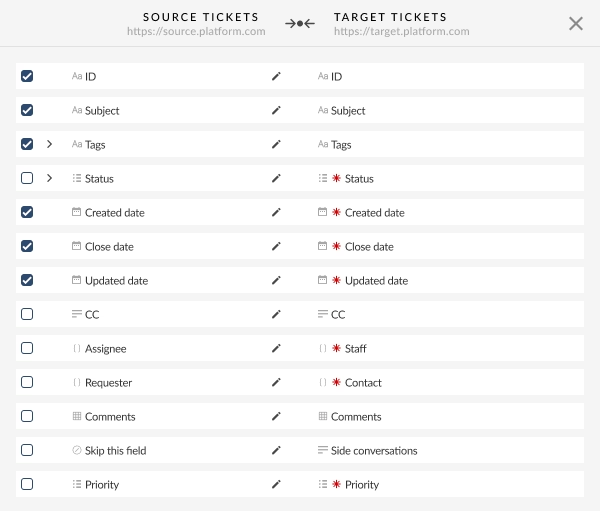
Match fields between the source platform and Freshservice - tickets, contacts, custom fields, and attachments, with relationships intact. This is the step where the field-level table above gets applied to your actual data, not a generic template.
Run a Free Demo
Test the mapping against 20 real tickets and 20 KB articles before committing to anything. Run it as many times as needed; a Custom Demo lets you handpick which 20 records to preview instead.
Check the results
Review the demo output against what you expected, using the Freshservice Migration Checklist to confirm nothing was missed. Adjust mapping and re-run the demo until it matches.
Run the Full Migration
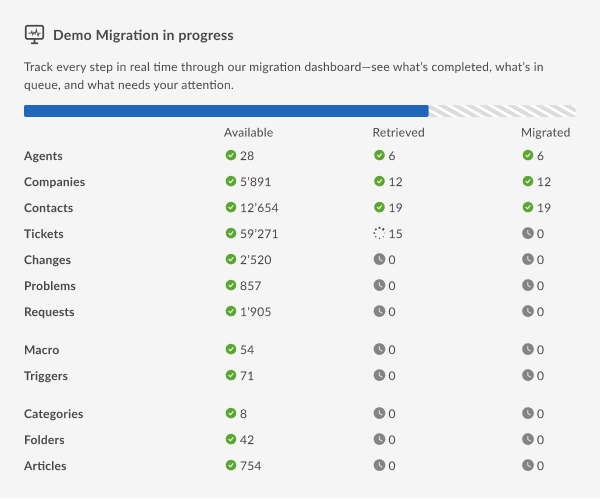
Schedule a time, and the migration runs in the background with no downtime on your live system.


Popular Freshservice Migration Routes
The most common paths into Freshservice, and one path out of it:
For support teams moving from customer-service ticketing to an ITIL-aligned service desk, taking tickets, contacts, and knowledge base articles with them.
For teams moving from Freshworks' customer-support product to its IT service management product, often when internal IT requests have outgrown a customer help desk.
For IT teams leaving ServiceNow's enterprise platform for a lighter ITSM tool that's quicker to set up, keeping incidents, requests, and history intact.
For teams moving the other direction, out of Freshservice, usually to bring IT service work into the Atlassian stack where engineering already runs.
For splitting one Freshservice instance into several, or merging several into one after a reorganization, merger, or regional split.
Help Desk Migration vs. manual import or a freelancer
Freshservice's own guidance on moving data in lists three routes: copy records by hand, hire a freelancer or developer, or use a migration service. Each has a real place - manual copy-paste can work for a handful of records, and a freelancer with API access can build something custom. Here is where each route tends to hold up and where it tends to break down:
| Capability | Manual copy-paste | Freelancer / developer |
Help Desk Migration
|
|---|---|---|---|
| Realistic scale | A few dozen records | Depends on the freelancer's Freshservice API experience |
Tested at 100+ platform pairs, tickets through custom objects
|
| Custom field mapping | Manual, error-prone past a handful of fields | Built per-project, cost scales with field count |
Field-level mapping built into the wizard
|
| Attachments and KB structure | Usually dropped or re-uploaded by hand | Depends on scope agreed up front |
Attachments, folder hierarchy, and article links preserved
|
| Timeline | Days to weeks, scales linearly with record count | Variable - depends on developer availability |
A Free Demo runs in minutes; full migration scheduled to a fixed window
|
| Cost predictability | Low - mostly staff time, hard to estimate upfront | Variable - freelance rates plus scope changes |
Fixed quote after a Free Demo, before you commit
|
| Support if something looks wrong post-migration | None built in | Depends on the contract |
Demo-first workflow catches mapping issues before the full run
|
Freshservice's own APIs are the foundation either route runs on - a freelancer and Help Desk Migration both build against the same public and bulk API endpoints. The difference is that Help Desk Migration has already built and tested that mapping layer across 100+ source platforms, so the same fixed-scope engagement covers a Zendesk migration, a ServiceNow migration, or a legacy CSV export without custom development for each one.
Manual copy-paste still makes sense for a genuinely small dataset - a new team starting with a few dozen open tickets rarely needs a migration tool at all. A freelancer makes sense when the requirement is narrow and custom, like a one-off script pulling a specific report out of a legacy system. Where both tend to struggle is scale combined with structure: hundreds or thousands of tickets that each carry custom fields, attachments, and a comment history, where a dropped field or a missed attachment on record 400 of 4,000 is easy to miss until an agent goes looking for it weeks later.
How Travis Perkins moved off a 12-year ServiceNow setup without losing HR data
Travis Perkins, a UK wholesale building materials company founded in 1988 with 10,000+ employees, ran ServiceNow for over 12 years before migrating IT and HR case data to Freshservice. Heavy customization had made new ServiceNow features hard to adopt, and their Configuration Management Database had become unreliable as automated discovery tools lost support.
The team segmented data by use case before migrating: open incidents, problems, changes, requests, and knowledge articles moved as operational data, while HR cases up to three years old moved alongside them. Archive data - closed IT tickets needed for audits and HR cases required for GDPR retention up to seven years - stayed in a separate archive rather than migrating into the live Freshservice instance.
"I think Help Desk Migration was brilliant. They quickly understood everything we explained and grasped the nuances of how our systems were set up, especially our ServiceNow database."
— Saagar K., Business Analyst at Travis Perkins
The team's main friction point was understanding Freshworks' own field mappings early on - a gap Saagar noted an upfront mapping walkthrough would have closed faster - and a first extraction pass from ServiceNow's archive that missed attachments, requiring a re-run for the HR dataset.
Freshservice migration without breaking Freddy AI
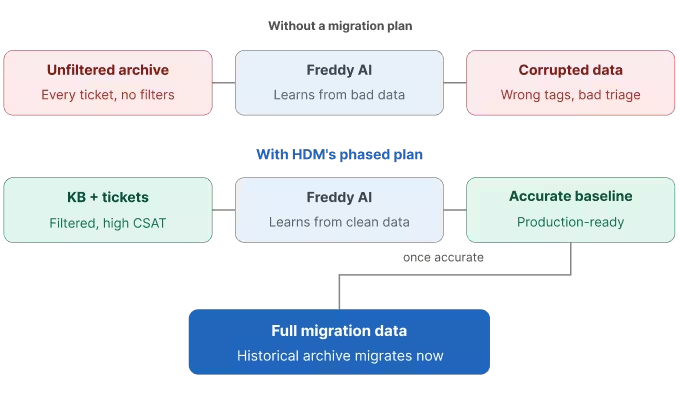
Freshservice's AI layer — Freddy AI Copilot inside tickets, the Freddy AI Agent in the employee self-service portal, and Freddy AI Insights for custom reporting — depends on the same tickets, KB articles, and historical resolution data a migration moves. If that data arrives incomplete or mis-mapped, AI suggestions and self-service answers degrade along with it, even though nothing in Freshservice itself is misconfigured.
To keep a Freshservice migration AI-ready, three things have to move intact — KB folder structure, full ticket conversation threads, and resolution history — and one thing has to be verified before the full run: Freddy AI's suggested answers against a demo migration. Here is what that looks like in practice:
- Migrate KB folder structure intact, not flattened. Freddy AI's search and suggestion features read from the article hierarchy itself, not just raw article text — a flattened knowledge base gives the AI layer less structure to work from.
- Move full conversation threads. A ticket that arrives as a bare subject and status line gives Freddy AI Copilot little to draw a suggested reply from; the same ticket with its full comment thread and resolution notes intact gives the Copilot the context it was designed to read.
- Run the Free Custom Demo against resolved tickets and KB articles specifically, not a random sample — it is the fastest way to see whether the data shape reaching Freshservice still supports the AI features that will read it. Provide ticket IDs and KB ID for the custom Demo Migration in the Migration Wizard.
- Check the AI Agent's suggested answers against that demo data before scheduling the full migration. Thin or off-target suggestions on the demo set mean the mapping needs adjusting before the full run, not after agents are already relying on it.
This matters most for teams migrating into a Freshservice account that already leans on Freddy AI Agent for self-service — confirming the data shape survives the move before it affects live self-service traffic is cheaper than fixing it afterward.

Your data stays secure and compliant during a Freshservice migration
GDPR-compliant
Help Desk Migration follows GDPR guidelines throughout a migration, handling personal and business data with the transparency and access controls the regulation requires - relevant to the HR and customer-record data that often rides along with an ITSM migration.
SOC 2 Type II certified
Both certifications come from independent audits of Help Desk Migration's security controls, covering the confidentiality, integrity, and availability of data the platform handles.
Encrypted in transit and at rest
Data is encrypted while it moves across networks during the migration and while it sits on Help Desk Migration's servers in between steps.
No third-party access
The migration path runs between your source platform, Help Desk Migration, and Freshservice - no other party gets access to the data in transit.
Freshservice's own security certifications apply once data lands in your account; Help Desk Migration's certifications cover the migration itself.
Freshservice Professional Services
Beyond moving the data, Help Desk Migration's team configures Freshservice around how your IT organization actually works. Setup and configuration cover:
- Designing service catalogs and request forms
- Configuring ticket fields, automations, and SLAs
- Setting up asset management and the CMDB
- Building incident, problem, and change management flows
A process audit reviews an existing Freshservice environment and flags concrete, actionable improvements rather than a generic checklist; system-integration work connects Freshservice to the CRM, ERP, HR software, and monitoring platforms already in use, reducing manual work between systems. Freshservice AI enablement configures Freddy AI's repetitive-task handling, resolution suggestions, and self-service capabilities for the specific ticket types and KB structure your team runs. Freshservice implementation support covers the full setup path in more detail.
Role-based training
Role-based training runs as focused sessions:
- admin configuration (~1.5 hours) covering how to configure, customize, and maintain Freshservice;
- agent training (~1.5 hours) on ticket handling, escalation management, and collaboration;
- Freddy AI bot deployment and optimization (~30 minutes);
- analytics and reporting (~1.5 hours) on building dashboards and monitoring KPIs;
- and an interactive Q&A session (~1.5 hours) scoped to your team's specific setup and questions.
The cost of a Freshservice migration
A Freshservice migration's cost is driven by three factors - data volume, requested customizations, and support package - and falls into one of two pricing models: a per-record self-service Migration Wizard for standard platform pairs, or a scoped, quoted managed migration service for heavier customization, custom-object mapping, or compliance requirements. There are no hidden fees layered on afterward in either case.
Self-service Migration Wizard
Priced per record, for teams whose platform pair and data shape fit the standard mapping - a straightforward fit when the migration does not involve heavy custom-object or compliance requirements.
Managed migration service
White-glove handling for complicated enterprise migrations - a dedicated project team scopes the engagement individually for heavier customization, custom-object mapping, or compliance requirements, rather than routing it through the standard self-service flow.
A Free Demo gives an accurate cost estimate before anything is scheduled for real, built from your actual data rather than a generic quote.
Get a migration cost estimate →
Ready to move your data into Freshservice
Start with a Free Demo against your own tickets and KB articles rather than a generic sample - it is the fastest way to see whether your current field structure needs any mapping decisions before a full migration, and it costs nothing to run. Book a call with a migration consultant if the migration involves custom objects, multiple workspaces, or a compliance requirement the standard wizard flow does not cover on its own.
Schedule a migration consultation →
No credit card required SOC 2 certified 60,000+ migrations completed
Freshservice Migration FAQ
Freshservice migration is the process of moving records - tickets, contacts, companies, agents, knowledge base articles, custom objects, and their relationships - from another help desk, service desk, or file-based source into a Freshservice account, without manual re-entry. Help Desk Migration automates this for tickets, contacts, organizations, agents, KB articles, attachments, custom objects, comments, tags, and ITSM-specific records like problems, changes, and tasks.
Help Desk Migration supports automated transfer from 100+ source platforms into Freshservice, including Zendesk, Freshdesk, Jira Service Management, ServiceNow, and most other help desk or ITSM tools on the market. If a specific platform pair is not listed on the migration routes above, it is worth asking directly rather than assuming it is unsupported.
Help Desk Migration has run ServiceNow-to-Freshservice migrations for organizations with over a decade of accumulated ServiceNow customization, including segmented operational and archive data and HR records under GDPR retention requirements, as in the Travis Perkins case study earlier on this page. ServiceNow to Freshservice migration covers the platform-pair specifics.
Duration depends mainly on record volume - small datasets can finish in minutes, larger or more complex migrations take longer, and a Free Demo gives a realistic estimate before the full run starts. The source system stays live and untouched throughout; migrated data is encrypted in transit and at rest, and Freshservice's own security certifications cover the data once it lands in your account.
Yes. Attachments migrate linked to their original tickets, and ticket notes, internal comments, and timestamps move with them, keeping the full history of each support interaction intact rather than just the ticket subject and status. That history matters for Freddy AI's resolution suggestions too - a ticket that arrives with its full comment thread gives the AI layer more to work with than a ticket that arrives as a bare subject line.
Yes - database dumps and CSV files migrate into Freshservice through the same mapping tool, handling varied formats and more complex data structures. This is distinct from moving between two Freshservice accounts or from another live help desk platform; a CSV source just means the mapping step reads from a file instead of an API.
Article categories, sections, and folder hierarchy - including nested subfolders - carry over intact, regardless of whether the source is Confluence, Freshdesk, ServiceNow, or another platform. Multilingual knowledge bases migrate correctly as long as the matching languages are already enabled in the Freshservice portal beforehand, and multiple source knowledge bases can merge into a single Freshservice instance in one migration.
Yes. Embedded images move with the articles they belong to, and internal links between articles can be automatically rewritten to point at the new Freshservice URLs, so cross-references between KB articles keep working after the migration instead of pointing at dead source-platform links.
Yes. Custom objects - assets, contracts, warranties, and other non-standard records - migrate with their relationships and field structure intact, and standard custom fields and ticket tags from the source system carry over as well. Complex custom-object mapping is scoped as professional services when it goes beyond the automated tool's defaults.
Yes. If your organization uses multiple Freshservice workspaces for different teams or departments, the migration targets the exact workspace you choose, rather than defaulting to a single account-wide destination. This matters most for organizations consolidating several business units into one Freshservice account, where each unit's data needs to land in its own workspace rather than mixing into a shared queue.