
We’ve seen many help desk solutions over the past couple of years. Some are bad others are great, and there are those who are in between. And yet, somehow, there are vendors that continue to impress over and over, despite being somewhat niche in nature. One such vendor is HubSpot Service Hub.
This seemingly generic customer management tool delivers on all fronts and offers an experience few help desk systems can replicate. But how does it achieve all this? And what is the HubSpot Service Hub pricing if it’s so good? Well, all this and more we will cover in today's HubSpot review. So, grab yourself a warm blanket and a notebook and start taking notes as we analyze all the bells and whistles of this help desk system.
HubSpot The Surface
Now we know that it’s tailored towards providing customer service, there is still a specific direction each help desk vendor pursues. In HubSpot’s case, it is to not only serve customers fast and effectively but to delight them as well. It seems trivial on paper but the company made massive efforts to implement a number of functions specifically aimed at this purpose.
That being said, the vendor made it clear that they intend to create a system that helps not only your sales team but marketers, suppliers, and customers alike. They firmly believe that when all departments are on the same page, the average service quality rate is significantly higher, not to mention more consistent. And frankly, we agree. The tool has everything you might need to enhance just about any aspect of your business, which leads us to the next section.
Service Suite
Now that we have a better understanding of the main mantra of the tool, let’s see what features it has and what you can expect from using them. Before we jump in though, we’d also like to note that the capabilities of the tool increase when you “link” it with other HubSpot products. So, the main feature set can be divided into two separate categories, namely, Basic Functionality and Advanced Functionality. Let’s take a look at each.
Basic Functionality
Just like every proper help desk out there, HubSpot Service Hub has a ticketing system that your agents can use to solve issues and a knowledge base system for your customers to serve themselves. The tool is also equipped with a dedicated feedback mechanism that you can implement just about anywhere.
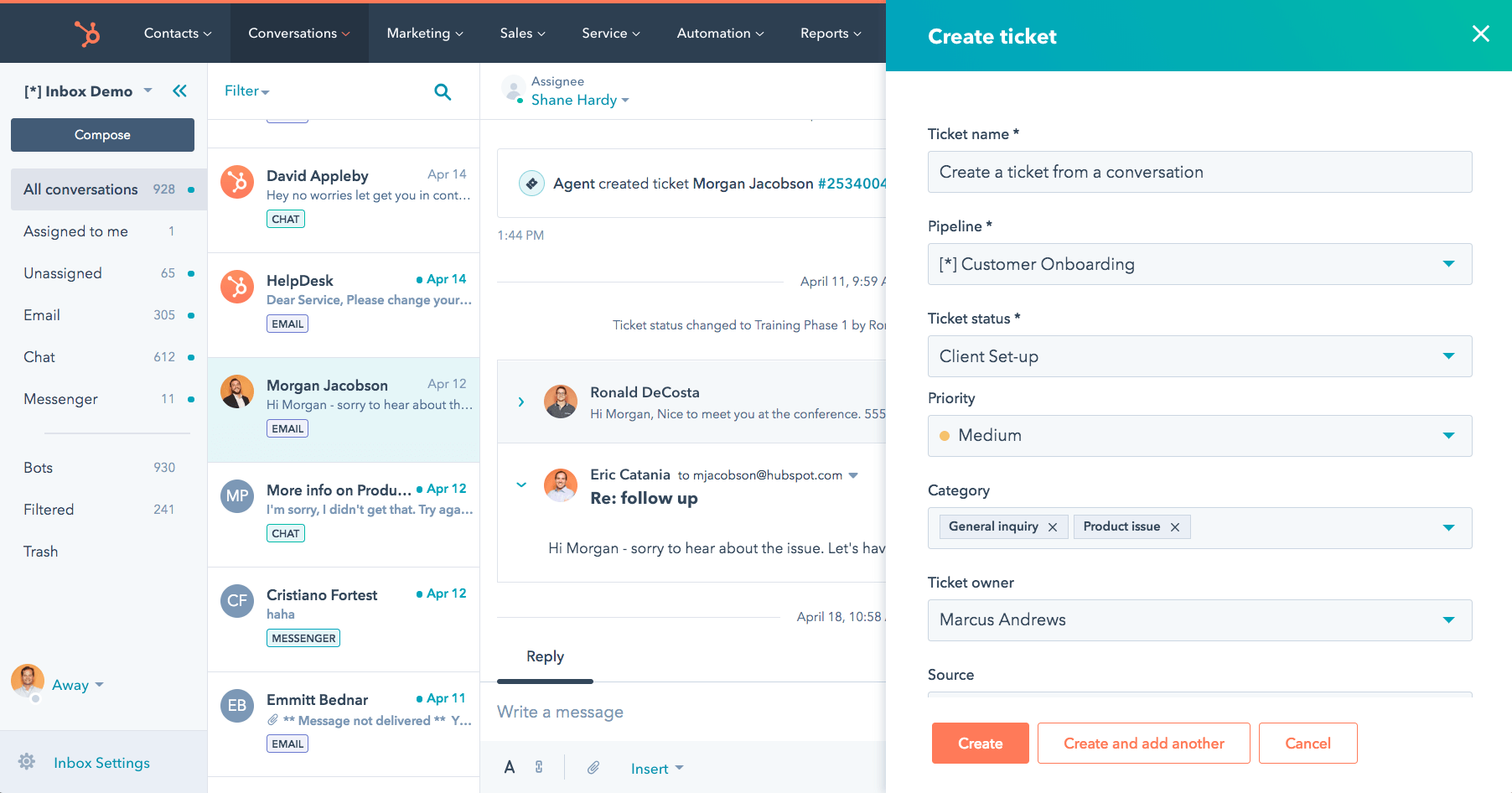
Creating a ticket and viewing the Inbox in Service Hub. You can use a number of filtering options to find tickets easier and also view the source channel when viewing all the conversations. Source: HubSpot
As for communication, you get access to a proper inbox solution and to a live chat tool. Also part of this system is the automated response function. With it, you can answer common issues that are submitted by the customers, as well as employees. Lastly, there are the automation and routing features that allow you to automatically deliver specific questions to the appropriate teams.
Advanced Functionality
Now that we’ve taken a look at the basic stuff, it’s time to explore the more advanced features. And the first thing that comes to mind is the Contact & company insights module. This function allows you to get helpful insights about the contacts and companies you have on your list.
Email System
Another thing that is worth mentioning is the email system. With it, you can easily see if your emails are sent, clicked, and more importantly, read. While it doesn’t provide pinpoint accuracy, it does help you understand what kind of information your customers are looking for. You can also set up an email schedule that can be coupled with the automation module which in turn will allow you to automatically send or stop sending stuff your customers like or dislike.
Preview how the emails you send will appear on different email clients. Source: HubSpot
Conversational Bot
There is also a conversation bot. This function allows you to set up an AI-powered (it seems AI is everywhere nowadays) chatbot that will guide your customers for you. The more it works the smarter it gets. But what’s really cool is that it sounds like a human and you will have a hard time figuring out whether it's a real person or not. The company made sure that its chatbot solution is heavily customizable. You can manually tweak the bot to meet your demands and let AI do the rest of the work. Something that we wish more companies would implement or at least replicate.
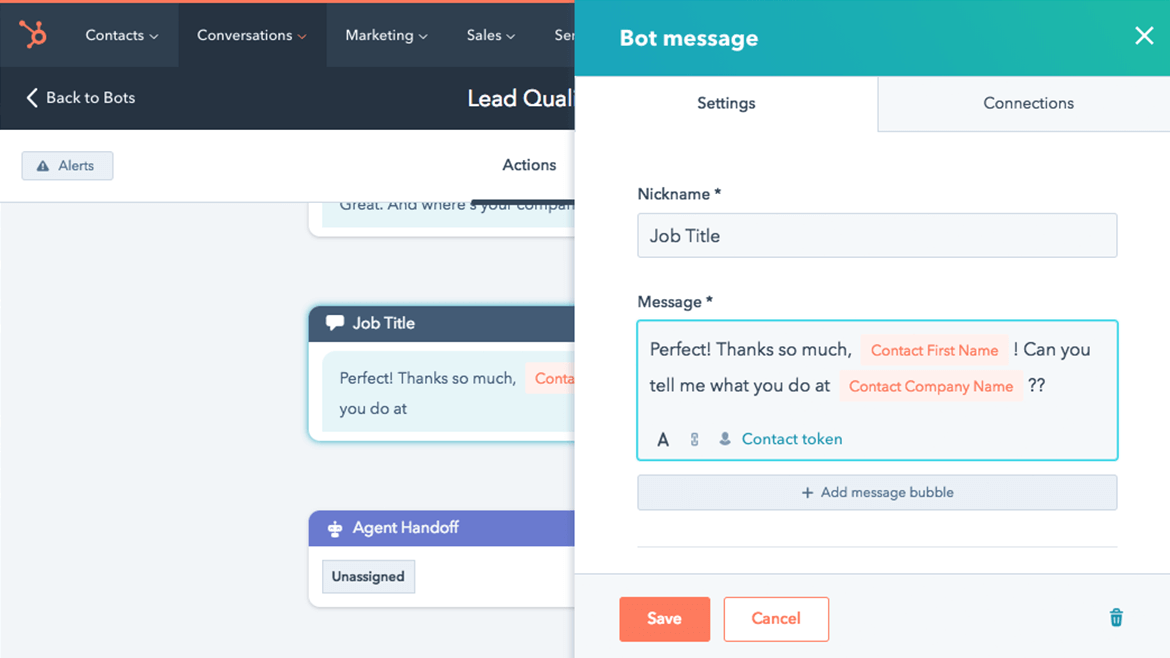
Customize the conversational bot for the messaging needs and sales process of your company. Source: Tree Group
Reporting System
Last but not least, you have the reporting tool that lets you gather data from across all of your channels and compile it into a graph of your choice. This functionality can also be hooked with the calendar system, meaning you will get the most relevant data possible on time.
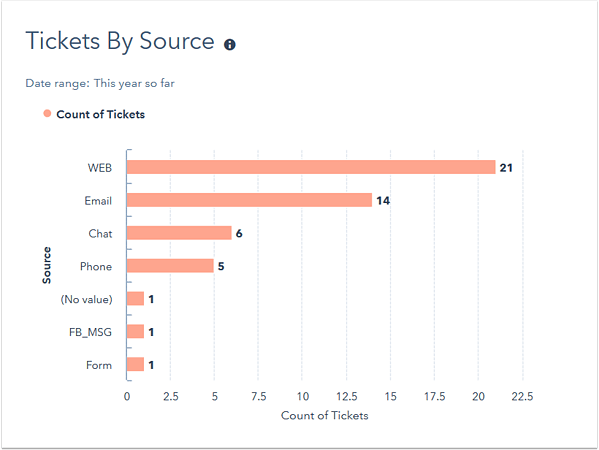
Report concerning the number of tickets that came in through different support channels. Source: HubSpot
Webhooks
This is a system that allows you to “hook” your currently used apps to HubSpot services in order to get notifications and other types of information. Not to be confused with the API system, webhooks are a completely different beast.
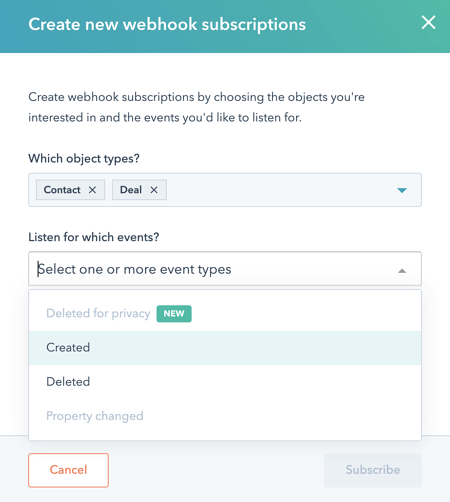
Creating a Webhook to subscribe to the events you want to be notified about. Source: HubSpot
And that’s pretty much wrapped for this section. Sure, there is a lot more but let’s take a look at the HubSpot Service Hub pricing.
Pricing Options
HubSpot Service Hub plans are designed to fit teams of all sizes, from brand-new startups to sprawling enterprises.
You can begin with their Free Tools at $0/month for up to 2 users, which is ideal for small teams needing basic support channels. If you need to scale, the first paid tier is Service Hub Starter, starting at $15 per seat/month (billed annually). If you want to align your support team with your marketing and sales pipelines, the Starter Customer Platform is also available at the same $15 per seat/month rate, unlocking foundational access across HubSpot’s broader CRM suite.
For growing teams that require automated ticket routing and SLA tracking, Service Hub Professional starts at $90 per seat/month (billed annually) alongside a mandatory, one-time $1,500 or $3,500 onboarding fees for the Professional or Enterprise tiers respectively.
It's also really important to mention that when choosing a HubSpot Service Hub plan, the billing frequency you select will heavily impact your overall software spend. Choosing annual you will save 33% on Starter plan.
| Plan | Monthly Cost | Users Included | AI Support | SLA | Setup Fee |
|---|---|---|---|---|---|
| Free Tools | $0 | Up to 2 users | Limited Basic bots | No | None |
| Service Hub Starter | $15/seat$20 month-to-month | Per seat | Yes500 credits | No | None |
| Starter Platform | $15/seat$20 month-to-month | Per seat | Yes500 credits | No | None |
| Service Hub Pro | $90/seat$100 month-to-month | Per seat Annual contract | Yes3,000 credits | Yes | $1,500 |
| Service Hub Enterprise | $150/seatBilled annually | 10-seat min. Annual contract | Yes5,000 credits | Yes | $3,500 |
What Sets HubSpot Service Hub Apart?
Service Hub is the engine that propels businesses toward delivering unparalleled customer service, marketing, and sales experiences, revolutionizing engagement and insights that supercharge the entire front office.
Within this dynamic hub, lies an arsenal of collaborative tools fostering seamless teamwork between Service, Sales, and Marketing. Playbooks, Email Templates, Sequences, and Meetings act as the catalysts, eliminating the fuss of connectors or data sync.
This robust hub not only brings organization but also streamlines service processes by centralizing customer information in the CRM. Tailoring ticket statuses ensures a fluid ticket pipeline that harmonizes perfectly with your unique workflows.
HubSpot serves as the quintessential tool, simplifying the storage, tracking, management, and reporting of customer tickets throughout the service cycle. Tailored reporting capabilities guarantee access to indispensable data vital for sustained growth. Service Analytics, the powerhouse of reporting systems, tracks customer satisfaction, team performance, and support volume.
Service Hub doesn't just foster connections; it deepens them. It facilitates effortless customer engagement with the support team and empowers customers to resolve queries independently through Knowledge Bases. Omni-Channel Messaging, Customer Portals, CSAT Surveys, and Conversation Intelligence features collaborate to elevate the customer journey, cultivating unwavering loyalty and elevating their overall experience.
HubSpot Service Hub Against Other Tools
And the last section of our HubSpot product overview is a comparison. After all, it is comparisons that highlight the pros and cons the most. We decided to stack it against Zendesk, HubSpot, and Pylon. Below we have outlined three core aspects of each tool - let’s take a look!
HubSpot VS Zendesk
When comparing HubSpot and Zendesk, it’s important to understand that HubSpot is essentially a CRM aligned with sales and marketing needs. Zendesk, on the other hand, stands as the industry's exclusively CS-centered help desk. If your focus is on:
- aligning customer support with sales pipelines and keeping a unified view of the customer journey - HubSpot’s all-in-one codebase is incredibly hard to beat;
- handling a high volume of complex tickets - Zendesk with its specialized, support-first tools puts its foot down.
On the grand scale, Zendesk definitely provides significantly deeper ticketing customization, native omnichannel voice routing, and robust internal SLA management — capabilities that can feel stripped-down in HubSpot's lighter, CRM-centric ticketing environment
HubSpot VS HelpScout
Teams often migrate from HelpScout to HubSpot, and there are several reasons for that. First, HubSpot offers a highly robust, sales-aligned ecosystem built on a central CRM, while Help Scout serves as the ideal alternative for brands that prioritize simplicity and a personal touch. If your team needs to:
- track complex customer journeys across marketing, sales, and support, HubSpot is your man;
- deliver conversational support without the feel of enterprise ticketing, Help Scout is hard to beat.
Help Scout operates like a clean, shared inbox that has got rid of robotic ticket numbers, making every support interaction feel like a direct, one-on-one email while offering essential collaboration tools. Plus, their interface has virtually zero learning curve.
HubSpot VS Pylon
While HubSpot Service Hub provides a comprehensive, CRM-driven support system, Pylon is a specialized, modern B2B alternative built specifically for tech and SaaS companies that live inside collaboration tools. If your goal is to:
- map support data directly onto marketing and sales pipelines, HubSpot remains the gold standard;
- communicate with enterprise clients through Slack Connect or Microsoft Teams, Pylon is exceptionally hard to beat.
Pylon operates as a "Slack-first" help desk, allowing you to turn unstructured chat threads into trackable support tickets and file development tasks in Jira or Linear. All of the former without requiring your agents or customers to leave their daily workspace.
A Wrap
It’s time we conclude this HubSpot review. We could have discussed much more, but there’s only so much time we have. Overall, we liked the tool and it delivered on promised. The HubSpot help desk cost seems steep at a glance but frankly, it is only a glance. You get a nice system that is packed with great features.
If you plan on using it and need to move your old stuff to the new tool, we can help. And if you don’t feel convinced, just . That way you will learn about everything firsthand and see what really clicks with your company. But for now, that’s all. See you in our next article.