
Merge or Split Zendesk Instances Without Missing a Reply
Move Zendesk to Zendesk without data loss, downtime, or operational disruption. Whether you are consolidating after an acquisition or separating environments by brand, region, or compliance needs, this data migration approach is built to keep agents working and customers receiving replies.
No credit card required Fast setup
Trusted by 40,000+ companies


Why merge or split Zendesk instances
Organizations merge Zendesk accounts after mergers and acquisitions, internal consolidation, or when reducing the overhead of maintaining multiple systems.
Teams choose to merge Zendesk instances when:
You acquired another company and need to merge Zendesk accounts so agents can see and reply with full historical context intact.
Teams need shared visibility and unified reporting dashboards across all support functions after Zendesk instance consolidation.
Multiple Zendesk instances lead to duplicated workflows, redundant automations, and gaps in reporting accuracy.
By choosing to merge Zendesk instances, teams eliminate duplicate workflows, reduce automation sprawl, and centralize SLA management while preserving historical data and minimizing disruption.
Splitting Zendesk instances becomes essential when brands, regions, or compliance obligations require independence.
Teams separate Zendesk instances when:
Workflows or SLAs conflict between departments or geographic regions.
Teams need operational autonomy to meet local regulatory or compliance requirements.
Separate reporting or branding is required for customer-facing support experiences.
This controlled Zendesk migration approach reduces workflow conflicts, misrouted tickets, and reporting errors, while giving departments or brands the freedom they need.
How Zendesk to Zendesk Migration Works
Prepare · Map · Test · Go-live · Validate
Prepare
A successful Zendesk to Zendesk transfer begins with detailed preparation:
- Select the target Zendesk instance (merge or split) based on business requirements.
- Align brands, forms, groups, and SLAs to match your intended architecture.
- Confirm admin-level access to both source and target Zendesk instances.
- Define the migration scope: full history or only recent and open tickets.
- Inventory all custom fields, macros, triggers, and automations, including dependencies.
- Identify archived tickets, merged tickets, suspended users, and edge cases that may require custom handling.
Map
Mapping defines exactly how data behaves after the migration:
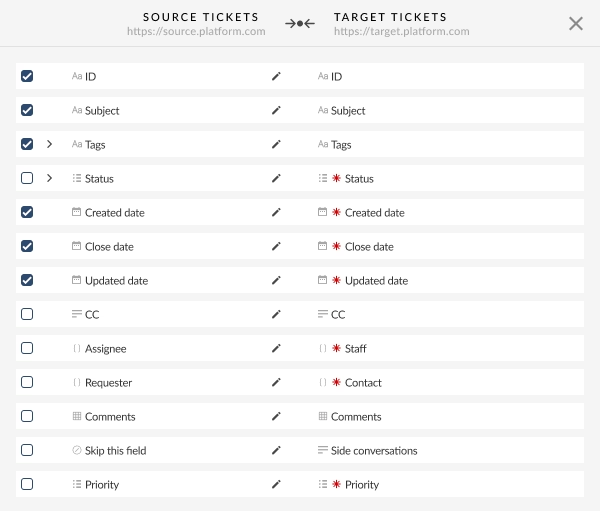
- Tickets: statuses, brands, forms, assignees.
- Users and organizations: deduplication, multiple-company associations, suspended user handling.
- Custom fields: dropdown normalization, tag behavior, and multi-form field handling.
- Rules: macros are fully migrated; automations are disabled during migration and re-enabled manually.
Test
Testing confirms accuracy and builds trust:
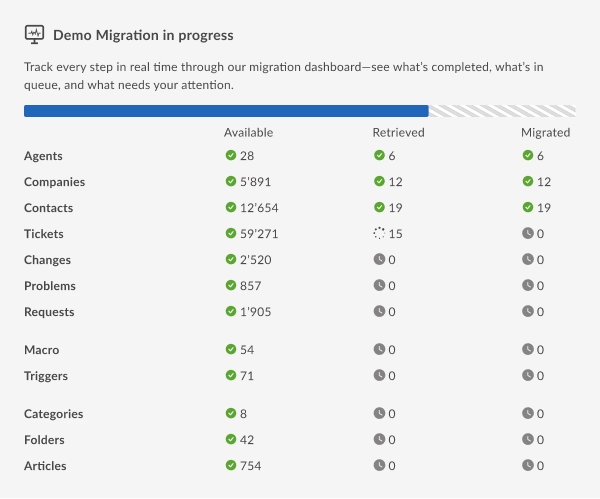
- Migrate 20 real tickets including edge cases like multi-brand tickets, merged users, and follow-ups.
- Review conversations, attachments, custom fields, and statuses for consistency.
- Refine mapping based on results and rerun Demo migrations if needed.
Go-live
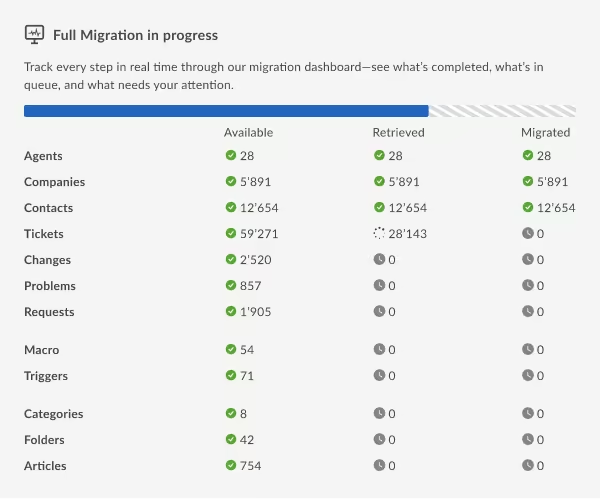
Full Migration runs while your source Zendesk stays live:
- Delta migration helps to move the new replies and agent updates during the cutover.
- Agents continue their workflows, and customers continue receiving support.
- Migration operates in the background to maintain full operational continuity.
Validate
This is a controlled customer service data migration process, not a self-serve gamble:
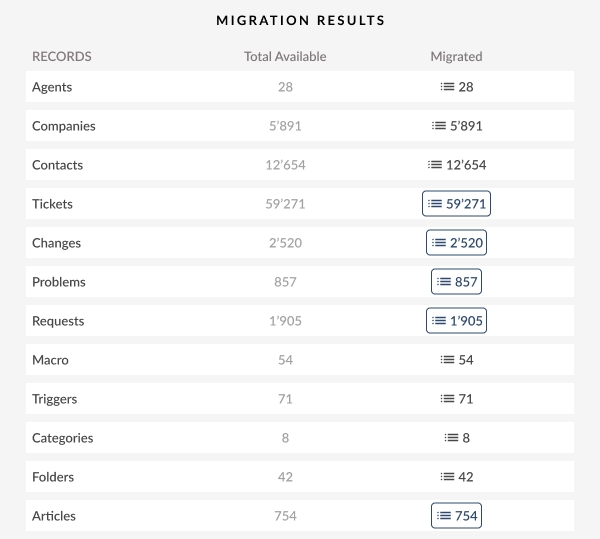
- Reconcile ticket and user counts to confirm all data migrated correctly.
- Rebuild Explore reports, as reporting data is not migrated by default.
- Re-enable automations intentionally to prevent unexpected triggers.
- Archive the source instance for compliance or record-keeping needs.
- This is a controlled customer service data migration process, not a self-serve gamble.
Consolidating Zendesk Instances Is Where AI Accuracy Is Won or Lost
A merge is not just a data move — it's a data-quality decision
When you combine two Zendesk instances after an acquisition, you're blending two tagging schemes, two knowledge bases, two CSAT baselines, and years of the acquired team's legacy tickets. Zendesk AI features — Intelligent Triage, AI agents, intent detection — learn from whatever you load. Merge everything at once and you train them on the noise of both instances combined.
That's why the order you migrate in matters as much as what you migrate.
The consolidation problem for Zendesk AI
- Two instances rarely share a tag taxonomy — merged blindly, categories collide and Intelligent Triage loses the signal.
- Duplicate contacts and organizations fragment customer history across records.
- Overlapping or contradictory knowledge base articles give AI agents conflicting source material.
- The acquired instance's oldest, unresolved, low-rated tickets dilute the data your AI learns from.
How we consolidate for AI-ready outcomes
Both steps run with zero downtime while your source instances stay live. You validate every mapping in a Demo Migration before any Full Migration commits.
Bring the clean signal first
We migrate resolved and closed tickets with strong CSAT, plus your full, de-duplicated knowledge base across all languages. Your unified instance gives Zendesk AI a clean foundation to work from on go-live day, not weeks later.
Bring the complete archive
Once the merged instance is validated, we migrate the remaining history — older tickets, unresolved threads, full contact and company records, and attachments — for complete institutional memory and compliance, without re-polluting the AI's working set.

Talk to a Migration Expert about an
AI-ready consolidation scenario
Common Zendesk to Zendesk Migration Issues We Handle
Issue 1: Inactive or default brands causing misrouting
Problem:
Inactive brands on the source instance may default to a selected brand on the target, potentially mixing tickets across brands.
Solution:
Help Desk Migration service filters and maps inactive brands according to your requirements, ensuring tickets land in the correct brand without confusion.
Issue 2: Dropdown fields generating unnecessary tags
Problem:
Dropdown fields across multiple ticket forms can create unwanted tags after migration.
Solution:
Tailor mapping to remove irrelevant fields and optionally disable content auto-tagging, reducing tag noise while preserving critical data.
Issue 3: Archived tickets not appearing in views
Problem:
Archived tickets exist in the system but do not appear in default views, leading to concerns that “tickets were lost.”
Solution:
All archived tickets are included in the data migration, and we guide you on confirming them via ID search or wildcards.
Issue 4: Solved vs Closed ticket discrepancies
Problem:
Solved tickets may auto-close after 28 days, impacting status tracking.
Solution:
We account for Zendesk automation behavior and you can map ticket statuses so historical records remain accurate, while you control future automations.
Issue 5: Timezone differences / UTC conversion
Problem:
API uses UTC; ticket timestamps can appear shifted by an hour after migration.
Solution:
Our service handles timezone normalization and provides post-migration verification to ensure timestamps align with your team’s local settings.
Issue 6: Light agent limitations
Problem:
Light agents cannot own closed tickets or post public comments, limiting how tickets appear in assignments.
Solution:
We pre-map light agent tickets and comments to appropriate agents, avoiding gaps in accountability.
Issue 7: IP restrictions or connection errors
Problem:
Migration tools can fail if source or target Zendesk instances restrict certain IPs.
Solution:
We guide IP whitelisting and secure configuration to prevent failures.
Issue 8: Zendesk search index mismatches
Problem:
Search-based ticket counts may not match actual ticket counts.
Solution:
Help Desk Migration Wizard validates counts via API data, and we can assist with reindexing if required.
Issue 9: Custom ticket statuses
Problem:
Only custom or default statuses can be mapped at once.
Solution:
We guide the client on disabling custom statuses and reconnecting the account, ensuring correct ticket status mapping.
Success Stories of Zendesk to Zendesk Migrations
UrbanYou preserved 200,000+ tickets after account consolidation
Industry:
Household Services
Issue:
UrbanYou needed to transfer over 200,000 historical tickets, contacts, attachments, notes, and KB content from an old Zendesk account into a newly created one after being acquired, but Zendesk’s native tools didn’t retain enough detail.
How we solved it:
UrbanYou conducted a free Demo migration, so they could verify ticket integrity, then executed a full automated migration with expert support guiding every step.
Outcome:
All historical support context, including tickets, attachments, and notes, was migrated seamlessly, giving agents immediate access to customer history without disruption.
“Migrating our Zendesk data with Help Desk Migration was an absolutely seamless experience.”
Noga Edelstein
Co-founder of UrbanYou

Roland Corporation done complex instance consolidation for a global support platform
Industry:
Electronics & Musical Instruments
Issue:
Roland needed to consolidate customer service data from a regional Zendesk instance into a central global one to unify support operations, a task involving tickets, contacts, companies, agents, and groups.
How we solved it:
Help Desk Migration applied a combination of automated and customized migration processes, carefully mapping key entities and preserving workflow structure across accounts.
Outcome:
A sophisticated Zendesk to Zendesk consolidation was completed successfully, with all critical data preserved and support continuity maintained.
"Honestly, I was really pleasantly surprised by how responsive the company is. I was left to wonder, do you guys even sleep? I was able to get responses to virtually every question each time I was asking within a few hours, even considering the time zones."
Paul McCabe
The Vice President of Global Customer Experience in Roland corporation

Ozonics LLC done an overnight migration to a functional Zendesk
Industry:
Outdoor / Consumer Products
Issue:
Ozonics LLC needed a fast, reliable way to migrate their existing support setup into Zendesk and have it fully operational by the next business day.
How we solved it:
The Help Desk Migration team guided them through a demo and full migration, allowing Ozonics to preconfigure Zendesk and run the transfer overnight.
Outcome:
By morning, Zendesk was fully functional with all historical data, eliminating downtime and manual re‑entry.
"The migration went as planned, we have not found any issues in the transferred data."
Stacey Hippen
Director of Operations at Ozonics LLC

Why Zendesk to Zendesk Migration Feels Risky (and How We Remove the Risk)
A Zendesk to Zendesk migration feels risky when done without visibility or validation.
Risk: Losing critical data
The thought of tickets, attachments, private notes, call recordings, or historical context being lost is enough to make teams hesitate. One wrong click could feel irreversible.
How Help Desk Migration handles it:
Our data migration service ensures every ticket, attachment, and conversation is migrated accurately. Demo migrations let you see your real data move safely before committing. Nothing is left behind, nothing breaks.
Risk: Downtime and disrupted support
Your agents continue to work, and your customers continue to reply. Support interruptions are unacceptable during Zendesk instance consolidation.
How Help Desk Migration handles it:
All Zendesk data migrations run in the background while Zendesk stays live. During the Delta migration, you can migrate the new activity, so support never stops, and SLAs remain intact.
Risk: Broken workflows, misrouted tickets, and incorrect mapping
Incorrect brands, forms, assignees, or statuses can stall teams and introduce confusion, miscommunication, and reporting errors during Zendesk instance consolidation.
How Help Desk Migration handles it:
Migration Wizard helps you map tickets, users, custom fields, macros, and triggers precisely. Edge cases such as merged tickets, follow-ups, or suspended users are handled automatically. You validate every mapping step, reducing risk to zero.
Risk: Cost, reporting continuity, and historical context
Migrating too much data can increase cost. Explore reports are not migrated by default. Attachments, screenshots, or notes could be missed.
How Help Desk Migration handles it:
Our data migration service lets you filter tickets and data, preserve reporting integrity, and capture every relevant historical detail. You stay in control of scope and cost.
What once felt risky becomes predictable, safe, and reversible. Agents keep working, customers keep getting replies, and leadership gets the confidence that the Zendesk to Zendesk switch will succeed.
With a Help Desk Migration Demo, you don’t guess but see it working before it matters.
No credit card required Fast setup

Help Center (Knowledge Base) Migration
Help Desk Migration transfers articles, translations, hierarchy, attachments, and metadata between Zendesk Help Centers while respecting platform limitations. Follow the guidelines below to ensure a complete and error-free migration.
- Guide Admin role required for all Help Center content.
- Access to all brands being migrated.
- Permission to manage languages and locales.
- Access to view archived or draft articles if they need migration.
- Each brand must be migrated separately using its brand URL.
- Multi-brand migrations are supported but tracked individually.
- If articles in different brands share slugs or IDs, they are renamed during migration to prevent conflicts.
- Default language must match between source and target.
- One-to-one locale mapping only. Multiple source locales cannot map to a single target locale.
- Deleted locales in the source may still exist in the API; migrating these will fail.
- Zendesk UI locale names may differ from API codes (e.g., fr-fr → French, fr → French (France)). Verify in Knowledge Admin → Settings → Language Settings.
- Articles without a default language are skipped unless assigned manually or via migration settings.
- Specific locales can be skipped if not needed.
- Draft and published articles: Migration preserves state. Drafts remain drafts; published articles remain published.
- Archived articles: Cannot be migrated. Restore as draft or published first.
- Folders & sections: Articles without folders are moved to a default folder. Section/category limits and maximum nesting depths are preserved but must be checked to avoid silent failures.
- Sorting and pinned articles: Order is preserved where possible; custom positions may require post-migration adjustment.
- Images, files, tags, and formatting are migrated as-is.
- Embedded videos require unsafe content to be enabled in Zendesk.
- Links inside articles are updated if Update Crosslinks is enabled; otherwise, redirects must be manually configured.
- Labels and tags are preserved.
- Custom article fields may need mapping; unsupported fields are skipped.
- Author attribution: Original authors are preserved if users exist in the target; otherwise, migration assigns the API user.
- Article creation and update dates are maintained where possible.
- Update Crosslinks preserves internal links.
- Redirects are required if crosslinks are disabled.
- Slugs are renamed automatically if duplicates exist in the target Help Center.
- Migration is idempotent if the same articles are migrated again: updated articles overwrite previous versions.
- Deleted articles or removed translations in the source are not automatically removed from the target.
- Provide a list of articles for selective migration. If fewer than 20, this can be done in a demo using Demo with Custom Data.
- Archived articles (restore first to draft or published).
- Channel field data.
- Spam tickets (Suspended tab).
- Certain unsupported custom fields.
- Newly migrated content may take time to appear in search results.
- Indexing delays are normal and should be expected after migration.
- Archived articles: Even custom ones cannot be migrated. To include them, you must first restore them as draft or published articles.
- Channel field data: Zendesk does not allow migration into the channel field, so this information cannot be moved to the default field.
- Spam tickets: Tickets in the Suspended tab are not migrated.
Don’t guess. Validate your Zendesk to Zendesk migration without downtime
Zendesk to Zendesk Migration FAQs:
Technical Details That Matter
- Form mapping: Ticket forms can be mapped between source and target.
- Dropdown fields: Values from dropdowns on other forms are automatically added as tags by Zendesk. This behavior cannot be prevented.
- Custom mapping: Unneeded fields can be excluded to reduce tags.
- Disabling tags: Zendesk can disable automatic tagging; content-based auto-tags (Guide) can also be disabled, but dropdown field tags remain unless removed from mapping.
- Tickets can only remain in New status if unassigned.
- When a New ticket is assigned to the default agent, Zendesk automatically changes its status to Open.
- Therefore, New status is excluded from migration mapping to Zendesk.
- Mapping: Either default or custom statuses are shown for mapping, never both at the same time.
- Switching to default statuses: To map default statuses, deactivate custom statuses in your account and reconnect.
- Ticket behavior: Tickets in custom statuses are treated as closed—they retain all closed-ticket characteristics (cannot be edited, remain in the Closed category) even if automations exist, but their status name does not change.
- Automated mapping: All triggers are migrated.
- Reviewable details: Every condition and action is displayed for verification.
- Critical: If any action is skipped, the trigger will fail after migration.
- Available for — defines which roles can use the macro.
- Title — the macro’s name.
- Body — the content or instructions applied by the macro.
- Actions — all macro actions are mapped explicitly. If any action is skipped or left unmapped, the macro will fail after migration.
- Macros: active/inactive status, category, or group. By default, all macros migrate.
- Triggers: active/inactive status or category. By default, all triggers migrate.

Olha Butenets
Olha is a distinguished help desk migration expert and an esteemed lead for our Sales and Support team. With over 4 years of experience and a track record of 2000+ successful migrations, she specializes in masterminding high-stakes enterprise data migrations while focusing on total data integrity and operational continuity.
Zendesk to Zendesk Migration Made Easy
Consolidate your Zendesk customer records in just a few clicks. Our solution handles the migration so you can focus on what matters—solving your customers’ requests.
Explore more helpful data migration guides
Looking for more? Our updated resources offer valuable guides on enhancing customer service and handling help desk data migration. Check them out now!

Freshdesk Alternatives 2026 — Compare Features, Pricing & Top Picks
As businesses aim to deliver exceptional customer support, the demand for Freshdesk alternatives ...

Top 16 Service Desk Software Solutions for Your IT Company Ranked
The internet is full of different tools and platforms to manage your business ...

Best Free Help Desk Software: Reviews, Features, Pricing in 2024
Discover the power of the best free help desk software, empowering businesses to ...
Zendesk® is a registered trademark of Zendesk, Inc. Help Desk Migration is not affiliated with, sponsored by, or endorsed by Zendesk, Inc. We provide data migration services that work with Zendesk's platform.