
Most osTicket exports are happening for one reason: the team has outgrown the tool and is moving to a modern help desk. This guide covers the export step in detail, then shows you the fastest way to migrate the exported data into Freshdesk, Zendesk, Help Scout, or any major help desk — without rebuilding tickets and users by hand.
Why Teams Export osTicket Data
Teams export osTicket data for operational, strategic, and compliance reasons. One of the most common drivers is migration to a more advanced help desk platform. As support operations grow, companies often need better automation, reporting, or integrations than osTicket can provide, making data export the first step in a smooth transition.
Let’s start with the basics and make things clear. osTicket doesn’t offer a native solution to export knowledge base elements and this is a massive issue as for many, the knowledge base is like a reference book that both new and old employees use. In other words, it is pretty important and not having the ability to move your base is a rather substantial con.
Anyways, since there is no way to move your data using a native implementation, your next best thing would be to copy-paste the entire base. This is suboptimal at best and will only work for companies that don’t have a large base. Yet, if you have a huge library of helpful and functional articles, complete with pictures, copy-pasting everything will take forever.
If you have a huge library of helpful and functional articles, complete with pictures, copy-pasting everything will take forever. And, if you try to use free migration apps, be aware that they might mismatch the data due to the lack of funding.
You can opt to use free third-party apps to move your stuff, however, be aware that these don’t always work. And those that work might mix and mismatch data. Moreover, these free migration systems aren’t always safe to use. And for good reasons, they lack the funding to establish a powerful protective system. If you have sensitive data that you wish not to expose, keep reading as we have just the tool for you.
Method 1: SQL Database Export (Full but Technical)
Exporting data directly from the osTicket SQL database gives you complete access to all stored information, including tickets, users, threads, attachments, and custom fields. This method is ideal if you need a full backup or want to perform advanced data manipulation.
However, it requires technical knowledge. You’ll need access to your database (typically via phpMyAdmin or command line tools) and an understanding of the osTicket database structure. Extracted data is not immediately human-readable and often requires additional processing to be usable in another system. This approach is best suited for developers or teams with database expertise.
Method 2: CSV Export from Admin Panel (Limited)
osTicket provides a simpler way to export data through the admin panel, usually in CSV format. This option is more accessible and doesn’t require technical skills, making it suitable for quick reporting or basic data extraction.
That said, the functionality is limited. You may only be able to export certain data types, such as tickets or users, and important elements like attachments, ticket threads, or custom fields might not be included. This makes CSV export less suitable for full migrations but useful for lightweight analysis or record-keeping.
Method 3: Direct Migration to a New Help Desk (Recommended for Switchers)
For teams planning to move away from osTicket, direct migration using a dedicated tool, such as Help Desk Migration, is often the most efficient option. Instead of manually exporting and restructuring data, the migration service can transfer tickets, contacts, attachments, and other records automatically to a new platform.
This method minimizes downtime, preserves data relationships, and reduces the risk of errors. It also eliminates the need for technical involvement in most cases. For growing teams or businesses switching to a more advanced help desk, direct migration offers a faster, more reliable path compared to manual exports.
Using the Help Desk Migration Wizard
To start using our tool, follow these steps:
1. Go to the .
2. Select your Source platform and Target platform.
If you’re unsure where to migrate your data, you can choose to export it as a CSV file instead.
3. Provide the required credentials to connect both platforms securely.
Access credentials are required to securely transfer data from osTicket. If security is a concern, your data is protected with advanced encryption and industry-standard security measures, ensuring it remains secure and inaccessible to unauthorized parties throughout the process.
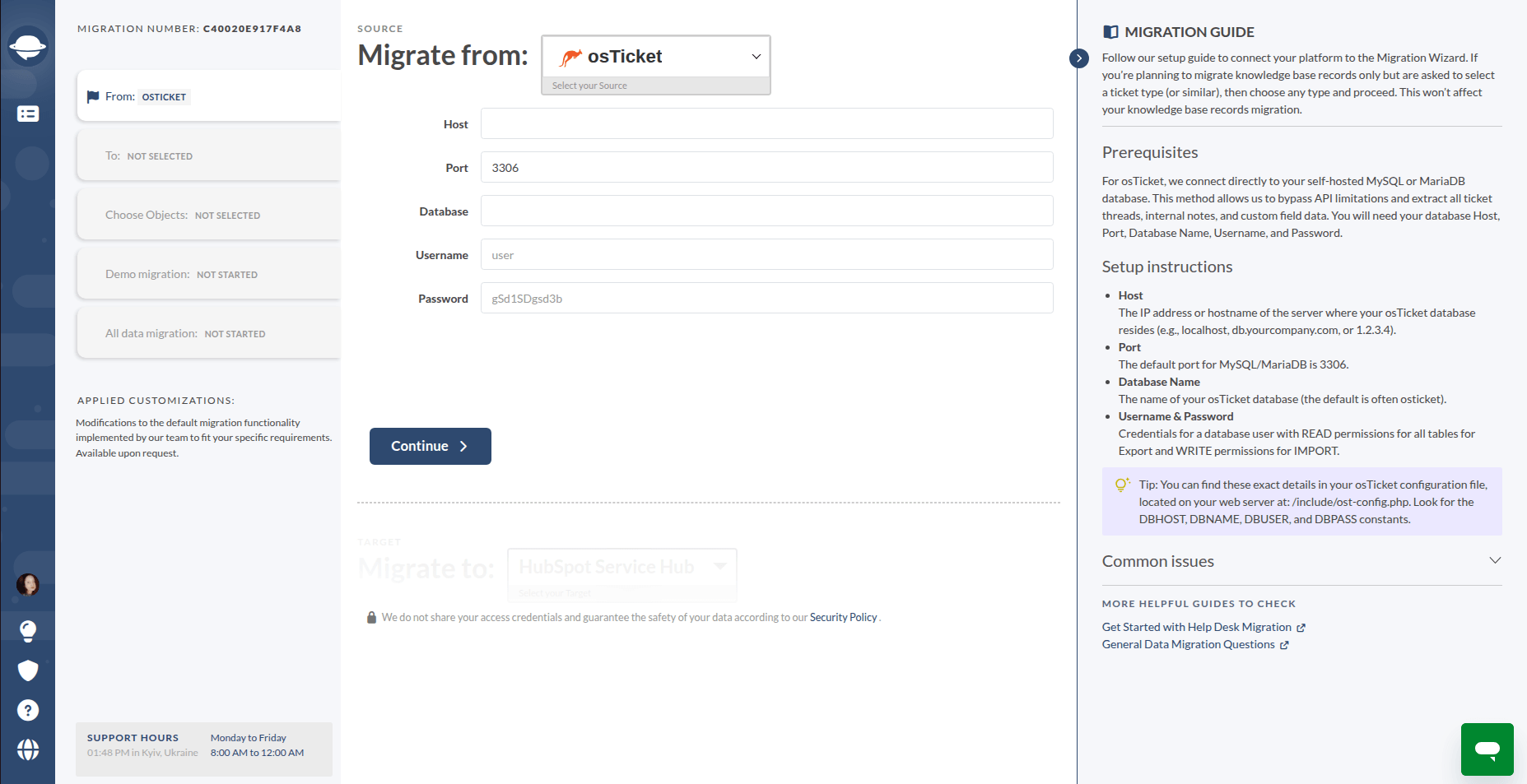
4. Once the Migration Wizard connects to your system, you’ll be prompted to choose the data you want to transfer. The tool will then run a free Demo Migration, moving 20 articles (including images) to ensure everything is mapped correctly and transferred without issues.
5. After the Demo, you’ll receive a clear estimate of the Full Migration cost, so you can decide whether to proceed.
6. From there, the process is fully automated — the tool handles the rest while you stay focused on your work.
osTicket → Freshdesk
Migrating from osTicket to Freshdesk is a popular choice for teams looking for a user-friendly interface with strong automation features. Freshdesk offers built-in ticketing workflows, SLA management, and multichannel support, making it easier to scale customer service operations. A direct migration helps transfer tickets, contacts, and attachments while preserving their structure.
osTicket → Zendesk
Zendesk is a robust, enterprise-grade platform with advanced customization, reporting, and integration capabilities. Teams moving from osTicket often choose Zendesk for its flexibility and scalability. A structured migration ensures that historical tickets, user data, and conversations are accurately transferred without disrupting ongoing support.
osTicket → Help Scout
Help Scout is ideal for teams that prefer a clean, email-like support experience. It focuses on simplicity, collaboration, and customer-centric communication. Migrating from osTicket to Help Scout allows teams to retain essential data while adopting a more intuitive interface for handling customer interactions.
osTicket → HubSpot Service Hub
HubSpot Service Hub is a strong option for companies that want to combine customer support with CRM capabilities. By migrating from osTicket, teams can unify support data with sales and marketing activities, gaining a complete view of the customer journey. A proper migration ensures seamless transfer of tickets and contacts into the HubSpot ecosystem.
Let’s Move Your Data Together
If you are still on the fence whether you should use our solution, we offer a free demo to everyone. After all, why read it a hundred times when you can see it in action. To claim your demo just give us a call or drop us a message, we’ll schedule a convenient time for you, and the rest is on us.
FAQ About How to Export osTicket Data
Yes, but native export options are limited and often exclude attachments, full conversations, or custom fields. A full SQL export can provide complete data, but it requires technical skills. For most teams, a Help Desk Migration tool is a good choice because it preserves structure, relationships, and attachments without manual processing.
The easiest method is using a Help Desk Migration tool, which automates the entire process. It transfers tickets, users, attachments, and knowledge base content without manual effort. Compared to CSV or database exports, it is also the most reliable option, reducing errors and ensuring data consistency during the migration.
Yes, if you use a trusted provider. Help Desk Migration tools use encrypted connections and strict security standards to protect your data. Credentials are only used to establish a secure connection for the transfer and are not stored or shared. This makes it a safe approach for migrating sensitive support data.
Yes, but not through native export functions. Manual methods like copy-paste are time-consuming and error-prone. A Help Desk Migration tool is the top solution because it transfers articles, including images, formatting, and structure, ensuring your knowledge base remains intact in the new system.
The migration timeframe depends on the volume of data and the method used. Manual exports or SQL-based approaches can take considerable time and technical effort to complete. In contrast, a Help Desk Migration offers a faster and simpler process. A quick Demo Migration also helps confirm the setup before running the Full transfer.